Jacksonville, FL guide
How an AC should be sized for a Jacksonville home
Why the rule of thumb fails in a humid climate, what a Manual J load calculation actually measures, and the questions to ask before you accept a tonnage.
By Glenn Milburn, HVAC Guides Editor Updated September 2026
Quick answer
How should an air conditioner be sized in Jacksonville, FL?
An air conditioner in Jacksonville should be sized with a Manual J load calculation that accounts for windows, insulation, orientation and air leakage, not by square footage. In this humid climate an oversized system short-cycles and fails to dehumidify, so correct sizing matters more than brand.
Why the rule of thumb fails
For decades, air conditioners were sized with a shortcut: roughly one ton for every 400 to 600 square feet. It's quick, and it's often wrong. Two homes of the same size can need very different capacity depending on their windows, insulation, shade, ceiling height and how leaky they are.
The shortcut also tends to err big, because an oversized unit at least cools the house quickly and nobody complains about that on day one. In Jacksonville, the problem shows up later as a house that feels cool and clammy at the same time.

What oversizing does in a humid climate
An air conditioner removes moisture only while it runs and its coil is cold. An oversized system hits the thermostat setpoint in a few minutes and shuts off before it has pulled much water from the air. It then starts again shortly after, over and over, which also wears the compressor faster.
Here, where the muggy season stretches from May through October, that short-cycling means the house carries too much humidity all summer. Lowering the thermostat to compensate costs money and makes it cold and damp rather than comfortable.
What a Manual J actually measures
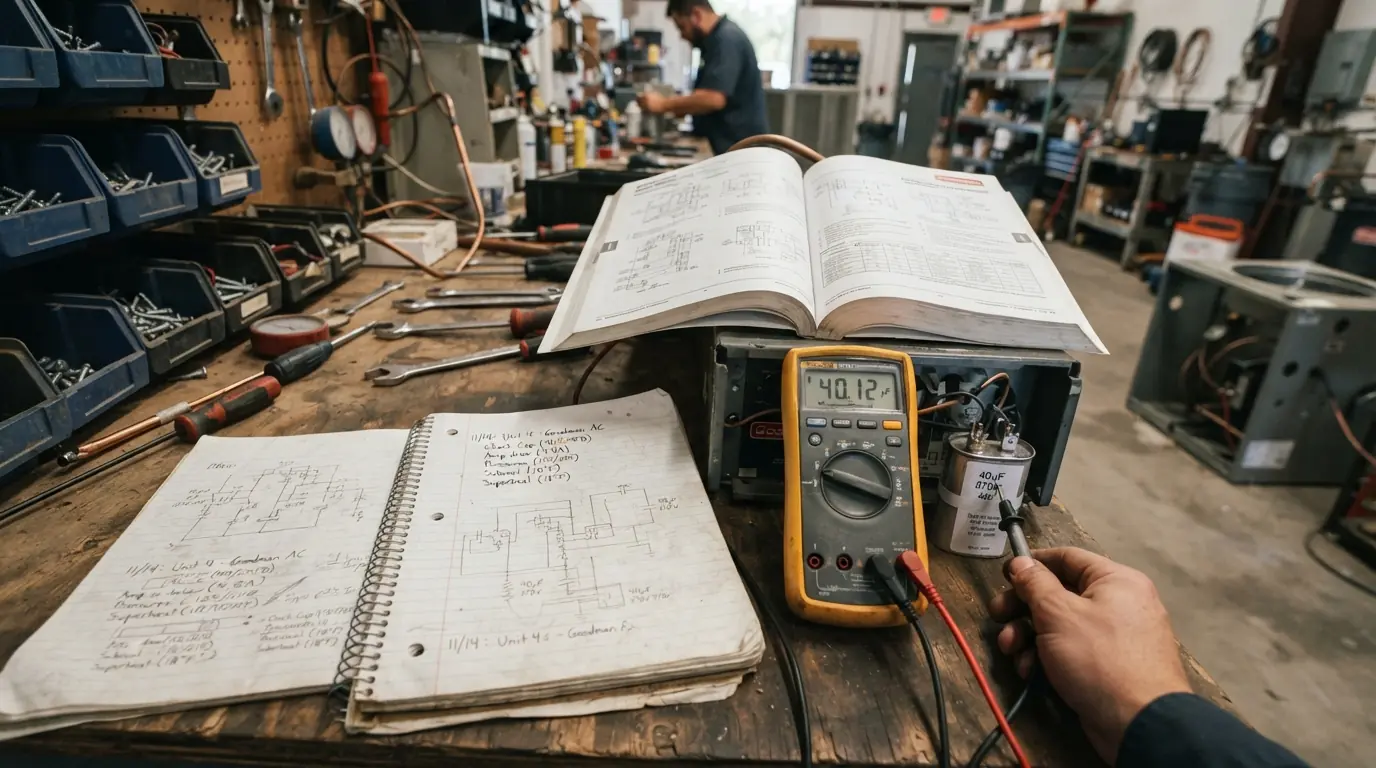
Manual J is the industry standard method for calculating how much heat a house gains in summer and loses in winter. It works room by room, using the square footage, ceiling height, wall and attic insulation, window sizes and types, which way each window faces, shading, the number of occupants, and an estimate of air leakage.
The result is a cooling load and a heating load in BTUs per hour, which then points to the equipment capacity. It also separates the sensible load, which is temperature, from the latent load, which is moisture, and that split matters in a humid city.
Want your house measured properly?
Call any hour. We'll run a Manual J before we recommend any equipment.
After the load calc: ducts and equipment
The load calculation tells you how much capacity the house needs. The duct design, usually done with Manual D, makes sure the ducts can deliver that air to each room. A correctly sized system on undersized or leaky ducts still performs poorly.
Equipment selection then matches the load, ideally with equipment whose latent capacity suits the moisture load. Variable speed systems help here because they can run long and slow at low demand, which keeps the coil cold and pulling moisture.

Questions to ask a contractor
Ask whether a Manual J will be done and whether you'll get a copy of the results. Ask why the proposed tonnage differs from the old unit, if it does. Ask how the ducts will be checked. A contractor who measures the house and explains the numbers is doing the job properly.
Be wary of a quote that simply matches the old unit's size without measuring anything. The old unit may have been oversized from the start.
What changes the load in a Jacksonville house
West-facing glass is one of the biggest single factors here; a wall of windows catching the afternoon sun can add more load than an extra bedroom. Attic insulation depth matters almost as much, because the attic above most homes gets far hotter than the outdoor air. Duct location counts too: ducts in a hot attic add load that ducts inside the conditioned space don't.
That's why two houses on the same street, built the same year, can need different equipment. One may have had windows replaced and insulation added; the other may still have its original single-pane glass and a thin attic.
Heating load still matters
Manual J calculates the heating load as well. In Jacksonville it's usually much smaller than the cooling load, which is one reason heat pumps fit so well here. The calculation confirms whether the chosen heat pump carries the house on a cold night or needs its backup strips, and how much strip heat to specify.
The rebate connection
A correctly sized, efficient system can also qualify for JEA's $200 rebate if it meets the program's 16 SEER2 minimum and is ENERGY STAR certified. Proper sizing and rebate eligibility aren't in conflict; a right-sized 16 SEER2 system usually beats an oversized one on comfort and running cost.
FAQ
Questions readers ask
Is one ton per 500 square feet accurate?
It's a rough shortcut that often oversizes homes. A Manual J is far more accurate.
What happens if my AC is too big?
It short-cycles, leaves the house humid and wears out faster.
What happens if it's too small?
It runs constantly on the hottest days and may not hold the setpoint.
Does a Manual J cost extra?
It's part of our replacement and installation quotes.
Should my new AC be the same size as my old one?
Only if the load calculation confirms it.
Does duct design matter too?
Yes. The ducts must deliver the airflow the system needs to each room.
How long does a load calculation take?
Measurements take an hour or so on site; the calculation follows.
Keep reading
Related services and guides
Why the house feels humid with the AC on
The reason a system can hit the setpoint and still leave the air damp, how to tell if it's happening, and the fixes in.
Learn moreWhat an AC replacement costs
Published price ranges for the city, the five things that move a quote up or down, and the rebate and tax-credit facts.
Learn moreQuestions to ask an HVAC contractor
Ten questions that reveal how a contractor sizes, installs and stands behind a system, and what good answers sound.
Learn moreSize it by the numbers
Call any hour to book a visit and a proper load calculation.