Jacksonville, FL
Condenser tie-downs and raised stands for Jacksonville homes
Tie-down clips and anchors that hold outdoor units to their pads, and raised stands that lift them clear of standing water, installed before storm season rather than after.
Quick answer
Do outdoor AC units need hurricane tie-downs in Jacksonville, FL?
Florida's mechanical code requires outdoor equipment exposed to wind to be installed to resist wind pressure, and tie-down clips anchoring the condenser to its pad are the usual way that's done on homes. Many older units were never anchored, or their pads have settled since. We check yours, add clips and anchors, and set raised stands where yards hold water.
What is included
Every tie-down and stand job includes
- Pad checked for level, cracks and settling
- Unit leveled before anchoring
- Clips fastened to the base rails and pad
- Corrosion-resistant hardware near the coast
- Stand height set from past water levels
- Refrigerant lines and whip extended if raised
- Disconnect and clearances checked
- System tested after the work
Overview
Keeping the outdoor unit where it belongs
An outdoor condenser is a light metal box sitting on a pad, connected to the house by copper refrigerant lines and a power whip. In strong wind it can slide, tip or lift, and when it moves, those copper lines kink or break, the refrigerant escapes and the repair becomes far bigger than the cost of anchoring it ever was. Tie-down clips bolt the unit's base to the pad so it moves with the pad instead of on it.
Water is the other storm risk. A condenser sitting in standing water can have its electrical parts and compressor damaged, so in low-lying yards a raised stand that lifts the unit clear of typical flooding is worth considering. Both jobs are quick compared with the repairs they prevent, and both are best done before the season starts.
What we fix
Tie-down clips on an existing pad
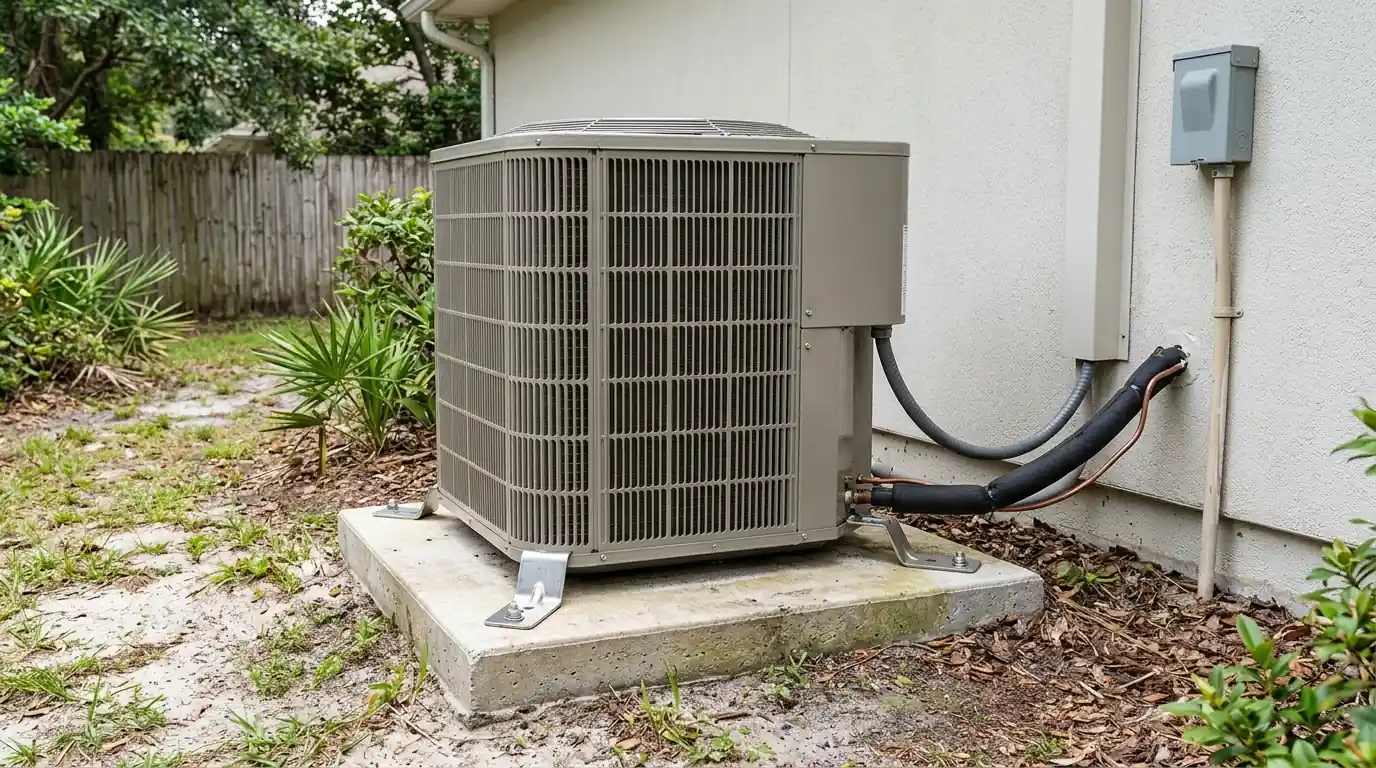
Most homes need only clips: brackets that fasten to the condenser's base rails with screws and to the pad with concrete anchors. We check that the pad is level and solid first, because clips on a cracked, sunken or tilted pad don't hold well, and a tilted condenser drains oil and condensate poorly as well. Near the coast we use corrosion-resistant hardware so the clips last as long as the unit. If the pad itself has failed, we replace it and set the unit back level before anchoring.
Raised stands for low-lying yards
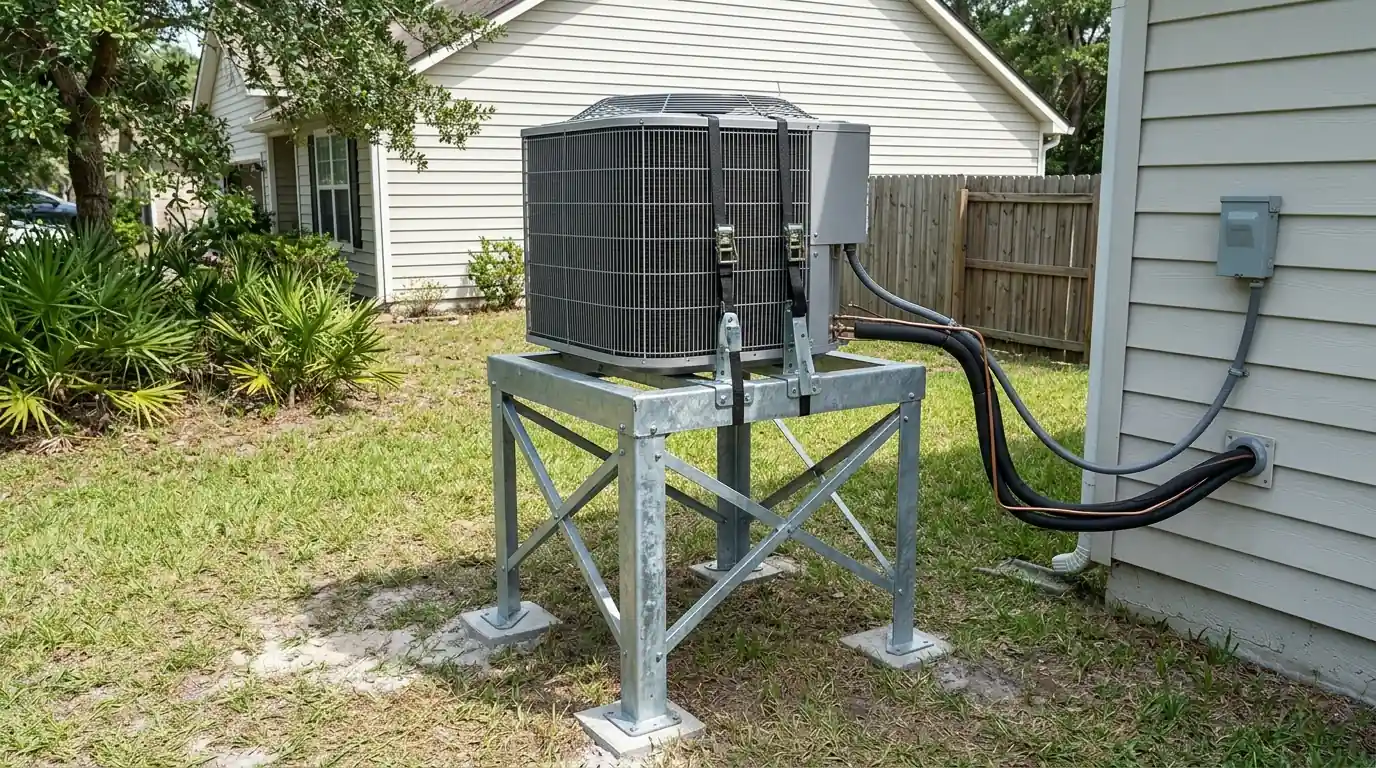
Where water stands after heavy rain, a raised stand lifts the condenser above the usual waterline. Raising a unit isn't just setting it higher: the refrigerant lines and electrical whip often need extending, the disconnect may need moving, and the stand itself has to be anchored to resist wind just like the unit on it. We look at where water has collected in past storms and how high the stand needs to be, then plan the line and electrical changes before quoting.
Package units and rooftop equipment
Package units on slabs and rooftop equipment on commercial buildings carry more weight and present a bigger face to the wind. They're anchored with brackets or kits made for the equipment, fastened to the slab, curb or roof structure the manufacturer specifies. On rooftops we also check that panels are secured and that anything loose nearby can't become debris. For businesses, we schedule the work around opening hours, photograph each anchored unit and write down what was done, which is useful for insurance files and for the next storm-season check.
What Florida's code expects from outdoor units
The Florida Building Code, Mechanical requires mechanical equipment, appliances and supports exposed to wind to be designed and installed to resist the wind pressures set by the building code. In Jacksonville that applies to the condenser beside your house as much as to commercial rooftop units, and new installations are permitted and inspected against it. Older systems often predate careful anchoring, or their pads have settled since, so a tie-down check is worth doing before storm season.
How the job runs
How the job runs
- 1
Check
Pad, level, anchoring and past water levels inspected.
- 2
Written plan
Clips, pad or stand option priced.
- 3
Prepare
Unit leveled, or lifted for a new pad or stand.
- 4
Anchor
Clips fastened to the base rails and pad or stand.
- 5
Test
System restarted and checked.
Cost factors
What affects the cost of tie-downs and stands
- Number of unitsEach condenser or package unit anchored separately.
- Pad conditionA failed or tilted pad may need replacing first.
- HardwareCorrosion-resistant clips and anchors near the coast.
- Stand heightTaller stands mean more line and electrical changes.
- Permit and inspectionRequired when equipment is moved or reconnected.
We look at the pad and the yard first, then price the clips or stand in writing.
FAQ
Tie-down and condenser stand questions
Are AC tie-downs required in Florida?
Florida's mechanical code requires outdoor equipment exposed to wind to be installed to resist wind pressure; clips are the usual method on homes.
Will tie-downs keep my condenser safe in any hurricane?
They greatly reduce the chance of it sliding or tipping, but no anchoring can promise against every storm or flying debris.
Should I cover my outdoor unit before a storm?
No. A cover can trap moisture and turn into a sail; anchoring and clearing loose items around it helps more.
How high should a condenser stand be?
High enough to clear the water levels your yard has seen, which we judge from the site and past storms.
Does raising a condenser affect how it runs?
Not when the lines are extended and charged properly; we recharge and test it afterward.
Can you anchor package units and rooftop units?
Yes, with brackets made for the equipment, fastened to the slab, curb or roof structure.
What should I do if my AC sat in flood water?
Leave it off and have it checked before running it, since water can damage the electrical parts and compressor.
Related services
Other work on the same system
AC Tune Up
Coil rinse, drain flush, refrigerant and electrical checks before the muggy season.
Learn moreHVAC Maintenance Plans
Two scheduled visits a year and drain line care, for systems that run most of the year.
Learn moreHVAC Inspection
Detailed system inspections for home purchases, insurance and second opinions.
Learn moreCommercial HVAC Repair
Rooftop units and split systems for offices, clinics and shops, day or night.
Learn moreCommercial AC Installation
Rooftop and split system replacements planned around business hours.
Learn moreGet the outdoor unit ready before the season
Call any hour to book a tie-down check or a raised stand for a low-lying yard.